

If you've got a young family member, friend, or maybe you're just curious about what's happening with money and tech, you might've heard the buzz: young people are asking AI for financial advice.
It's a bit like asking your smart assistant what to cook for dinner, but instead, they're asking it how to budget, save, or invest. Sounds pretty modern, right? Let's break down what's actually going on, why it matters, and what to watch out for.
Ironically, this image was made with AI.
So, Who's Actually Doing This?
It's mostly Gen Z (that's people born roughly between 1996 and 2010), so they're around 18 to 28 years old today. Not exactly "little kids," but definitely the younger end of the financial world.
Here's what the numbers show:
About 1 in 5 Gen Z Australians (nearly 20%) turn to AI for money advice
Nearly two-thirds of Gen Z use social media for financial advice, and AI is becoming a big part of that
In the U.S., 80% of Gen Z and millennials are using AI for financial advice
And it's not just a tiny group experimenting. This is a real trend.
What Are They Asking AI About?
Gen Z isn't just asking AI dumb questions. They're using it for serious money stuff:
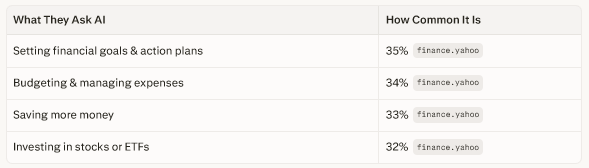
They're asking AI how to build a budget, save for a holiday, or even start investing. Pretty gutsy, if you think about it!
Why Are They Doing This?
There are a few reasons this is happening:
AI is everywhere – It's in our phones, our apps, our search engines. It feels natural to ask it questions.
It's instant – No waiting for an appointment or paying for advice. Just type and get answers.
It's friendly – AI doesn't judge you if you don't know what an ETF is.
Money stuff feels confusing – And AI makes it seem simpler.
Also, a lot of young people trust AI. About 64% of Gen Z say they trust AI platforms for financial info—16% completely, and 48% somewhat.
But Wait… Is This a Problem?
Yes and no. Here's the thing: AI can be a helpful tool for learning, but it's not a licensed financial adviser. And that's where things get risky.
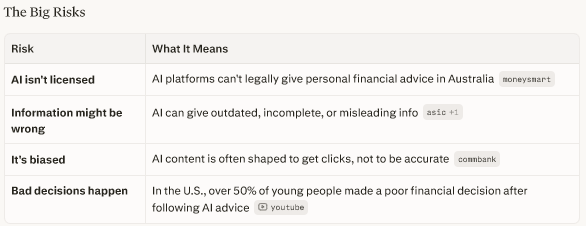
ASIC (Australia's financial regulator) noticed this trend and issued a warning in March 2026. They're urging young Australians to "sense-check" any money info they see online, especially from AI.
What Should Young People (and Their Parents) Do?
ASIC and Moneysmart (the government's money advice site) have some solid tips:
✅ Do This:
Use AI to learn concepts – Like "what is compound interest?" or "how do ETFs work?"
Verify with trusted sources – Check things against licensed advisers, Moneysmart, or your bank
Don't share personal info – Never put your account numbers, ID, or sensitive financial data into AI
❌ Don't Do This:
Don't treat AI advice as final – It's not personal, licensed advice
Don't skip the human element – If you're making big money decisions, talk to a real financial adviser
Don't trust everything you see – More than half of Gen Z trust financial content on social media, but that doesn't mean it's accurate
The Bottom Line
AI is a cool tool, and it's great that young people are trying to get their money sorted early. But financial advice is serious stuff. It affects your future, your savings, and your peace of mind.
Think of AI like a friendly info buddy—it can point you in the right direction, but it shouldn't be the one making decisions for you. When things get real (like investing, superannuation, or big purchases), talk to a licensed financial adviser.
And if you're a parent? Maybe have a chat with your young ones about this. You don't need to be a money expert—just help them understand that AI isn't a substitute for real advice.
Want to Learn More?
If you're curious about smart money habits or want to talk through your financial goals, we're here to help. No jargon, no pressure, just a friendly chat about your money.
We’ve also built and trained our own AI that’s specifically designed to give financial guidance. You can check it out and begin chatting today: aifinancial.com.au
Feel free to reach out or check out our other blog posts for more simple, practical money tips!
References: